
Oracle Apps 11i Tutorials : Oracle Flex fields
This chapter provides you with a conceptual overview of flexfields. The chapter covers the following topics The general features of flexfields, Flexfields terminology , The benefits of flexfields and Descriptive Flexfields.
Overview of Flexfields
Oracle flexfields is one of the most important parts of Oracle Applications. It is because of the flexfields that the Oracle Applications is so generic in nature and can be used to suit any industry or organization. A flexfield, as the name suggests, is a flexible data field that your organization can customize to your business needs without programming. A flexfield is a field made up of sub–fields, or segments. While flexfields do not require programming, they do allow you to perform significant customizations to the Oracle Applications, so they do require enough explanation for you to get the most out of the features they provide.
Oracle Applications uses two types of flexfields, key flexfields and descriptive flexfields. A key flexfield is a field you can customize to enter multi–segment values such as part numbers, account numbers, and so on. A descriptive flexfield is a field you customize to enter additional information for which your Oracle Applications product has not already provided a field.
Basic Business Needs
Oracle Applications flexfields let you satisfy the following business needs:
- Have “intelligent fields”—fields comprised of one or more segments, where each segment has both a value and a meaning.
- Rely upon your application to validate the values or the combination of values that you enter in intelligent fields.
- Have the structure of an intelligent field change depending on data in your application.
- Capture additional information if you so choose.
- Customize data fields to your meet your business needs without programming.
- Query intelligent fields for very specific information.
Key Flexfields
key flexfield is a field made up of segments, where each segment has both a value and a meaning. You can think of a key flexfield as an “intelligent” field that your business can use to store information represented as “codes.”
Most organizations use ”codes” made up of meaningful segments to identify general ledger accounts, part numbers, and other business entities. Each segment of the code can represent a characteristic of the entity. For example, consider an account number for a bank. A complete bank number may consists of various segments like the country code, area code, city code, branch code, account type, account number etc.


 Bank Number : [01].[002].[08].[S].[124467]


Country Code City Code Branch Code Account Type(Savings/Current) Account #
The number of segments a bank requires to identify an account number uniquely is a requirement specific to the bank. Another bank might not require a country code if its presence is there only in one country. Key flexfields are used to identify such information uniquely.
A key flexfield is flexible enough to let you use any code scheme you want to describe an entity. When your organization initially installs an Oracle Applications product, your organization’s implementation team customizes all the key flexfields in that product to use meaningful code segments to describe each key flexfield entity. Your organization decides for each key flexfield, how many segments an entity has, what each segment means, what values each segment can have, and what each segment value means.
Your organization can also define rules that govern what combination of segment values are valid (cross–validation rules), or define dependencies among the segments. The result is that your organization can use the codes it needs rather than change its codes to meet someone else’s requirements.
The Accounting Flexfield in your Oracle Purchasing application is an example of a key flexfield that identifies a unique chart of accounts. One organization may choose to customize the Accounting Flexfield to have three segments called Company, Department, and Account, while another organization may choose to customize the flexfield to have five segments called Company, Cost Center, Account, Sub–Account, and Product.
A key flexfield appears on your form as a normal text field with an appropriate prompt. In figure 1 below, the Account field is actually the Accounting Key Flexfield.
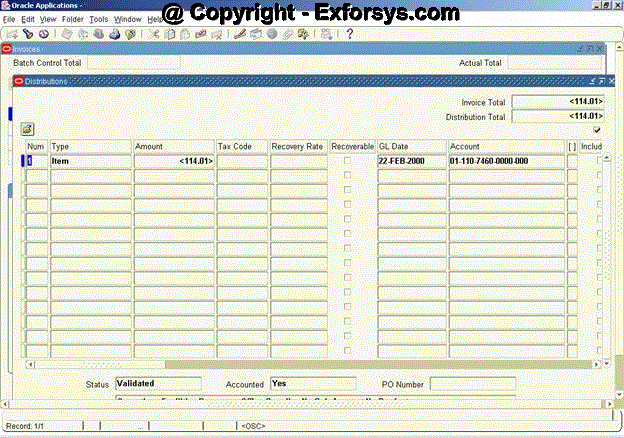
Figure 1. Key Flexfield in a form
A window pops-up when you navigate to the key flexfield as shown in figure 2 and it would require you to enter the various segments defined for the key flexfield.
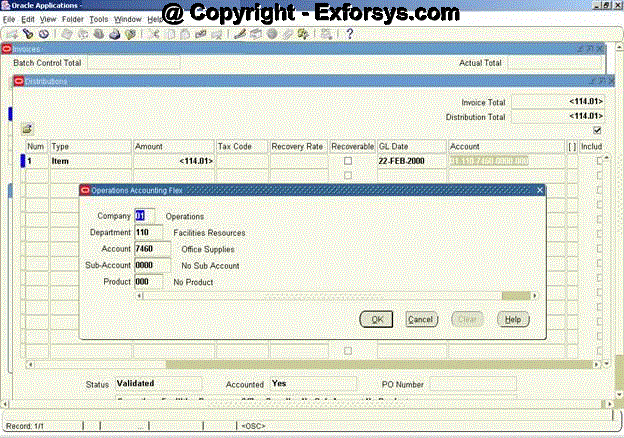
Figure 2. Key Flexfield Pop-up
Key Flexfields in Oracle Applications
The Oracle Applications products provide many key flexfields as integral parts of the products.
Here is a table listing all the key flexfields in Oracle Applications, ordered by the application that ”owns” the key flexfield. Note that other applications may also use a particular flexfield
|
Owner |
Key Flexfield Name |
Flexfield Code |
|
Oracle Assets |
Asset Key Flexfield |
KEY# |
|
Oracle Assets |
Category Flexfield |
CAT# |
|
Oracle Assets |
Location Flexfield |
LOC# |
|
Oracle General Ledger |
Accounting Flexfield |
GL# |
|
Oracle Human Resources |
Grade Flexfield |
GRD |
|
Oracle Human Resources |
Job Flexfield |
JOB |
|
Oracle Human Resources |
Personal Analysis Flexfield |
PEA |
|
Oracle Human Resources |
Position Flexfield |
POS |
|
Oracle Human Resources |
Soft Coded KeyFlexfield |
SCL |
|
Oracle Inventory |
Account Aliases |
MDSP |
|
Oracle Inventory |
Item Catalogs |
MICG |
|
Oracle Inventory |
Item Categories |
MCAT |
|
Oracle Inventory |
SalesOrders |
RLOC |
|
Oracle Inventory |
Stock Locators |
MTLL |
|
Oracle Inventory |
System Items |
MSTK |
|
Oracle Payroll |
Bank Details KeyFlexField |
BANK |
|
Oracle Payroll |
Cost Allocation Flexfield |
COST |
|
Oracle Payroll |
People Group Flexfield |
GRP |
|
Oracle Receivables |
Sales Tax Location Flexfield |
MKTS |
|
Oracle Receivables |
Territory Flexfield |
CT# |
|
Oracle Service |
Oracle Service Item Flexfield |
SERV |
|
Oracle Training Administration |
Training Resources |
RES |
{mospagebreak}
Descriptive Flexfields
Descriptive flexfields like the key flexfields provides further scope of customization in Oracle Applications.
Descriptive flexfields provide customizable ”expansion space” on your forms. Though the fields on an Oracle Applications form are more than enough to capture all the possible information from the user perspective, but still the users can feel the need of capturing additional information. A descriptive flexfield gives you room to expand your forms for capturing such additional information.
A descriptive flexfield appears on a form as a single–character, unnamed field enclosed in brackets ([ ]) as shown in figure 3 below.
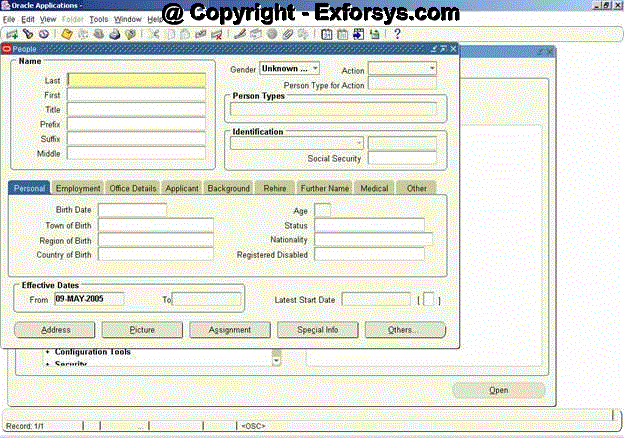
Figure 3. Descriptive Flexfield on a form
Oracle Applications has provided space for descriptive flexfields on almost all the forms. Just like in a key flexfield, a pop–up window appears when you move your cursor into a customized descriptive flexfield. And like a key flexfield, the pop–up window has as many fields as your organization needs. Each field or segment in a descriptive flexfield has a prompt (figure 4), just like ordinary fields, and can have a set of valid values. The pop-up as shown in the figure 4 comes up when you click on the [ ] icon on the form in the figure3 above.
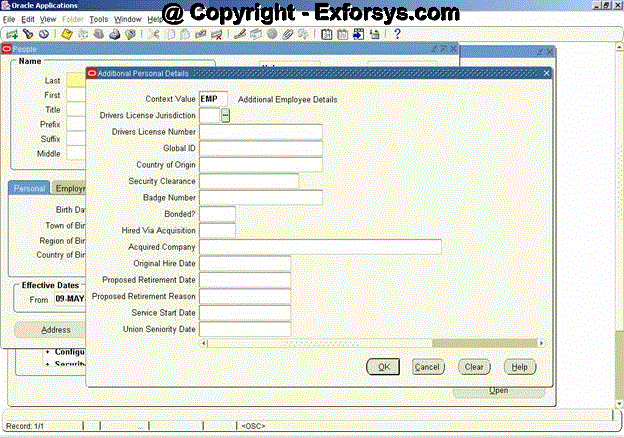
Figure 4. Popup for Descriptive Flexfield on a form
Further details about implementation and other features are provided in the implementation section later in the chapter.
[catlist id=183].