
Connective convenience
Unlike infra-red, Bluetooth does not require line-of-sight positioning of connected units. The technology uses modifications of existing wireless LAN techniques but is most notable for its small size and low cost. The current prototype circuits are contained on a circuit board 0.9cm square, with a much smaller single chip version in development. The cost of the device is expected to fall very fast, from $20 initially to $5 in a year or two. . They can establish a 1 megabit/s link (up to 2 Mbps in the second generation of the technology) with security and error correction, to use as required. The protocols will handle both voice and data, with very flexible network topography.
This technology achieves its goal by embedding tiny, inexpensive, short-range transceivers into the electronic devices that are available today. The radio operates on the globally-available unlicensed radio band, 2.45 GHz (meaning there will be no hindrance for international travelers using Bluetooth-enabled equipment.), and supports data speeds of up to 721 Kbps, as well as three voice channels. The Bluetooth modules can be either built into electronic devices or used as an adaptor. For instance in a PC they can be built in as a PC card or externally attached via the USB port.
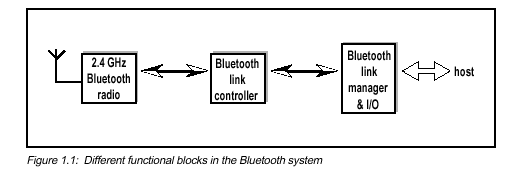
Each device has a unique 48-bit address from the IEEE 802 standard. Connections can be point-to-point or multipoint. Bluetooth devices are protected from radio interference by changing their frequencies arbitrarily upto a maximum of 1600 times a second, a technique known as frequency hopping. They also use three different but complimentary error correction schemes. Built-in encryption and verification is provided.
Moreover, Bluetooth devices won’t drain precious battery life. The Bluetooth specification targets power consumption of the device from a "hold" mode consuming 30 micro amps to the active transmitting range of 8-30 milliamps (or less than 1/10th of a watt). The radio chip consumers only 0.3mA in standby mode, which is less than 3 % of the power used by a standard mobile phone. The chips also have excellent power-saving features, as they will automatically shift to a low-power mode as soon as traffic volume lessens or stops.
Bluetooth radio technology provides a universal bridge to existing data networks, a peripheral interface, and a mechanism to form small private ad hoc groupings of connected devices away from fixed network infrastructures. Designed to operate in a noisy radio frequency environment, the Bluetooth radio uses a fast acknowledgment and frequency hopping scheme to make the link robust. Bluetooth radio modules avoid interference from other signals by hopping to a new frequency after transmitting or receiving a packet. Compared with other systems operating in the same frequency band, the Bluetooth radio typically hops faster and uses shorter packets. This makes the Bluetooth radio more robust than other systems. Short packages and fast hopping also limit the impact of domestic and professional microwave ovens. Use of Forward Error Correction (FEC) limits the impact of random noise on long-distance links. The encoding is optimized for an uncoordinated environment.
Bluetooth guarantees security at the bit level. Authentication is controlled by the user by using a 128 bit key. Radio signals can be coded with 8 bits or anything upto 128 bits. The Bluetooth radio transmissions will conform to the safety standards required by the countries where the technology will be used with respect to the affects of radio transmissions on the human body. Emissions from Bluetooth enabled devices will be no greater than emissions from industry-standard cordless phones. The Bluetooth module will not interfere or cause harm to public or private telecommunications network.
The Bluetooth baseband protocol is a combination of circuit and packet switching. Slots can be reserved for synchronous packets. Each packet is transmitted in a different hop frequency. A packet nominally covers a single slot, but can be extended to cover up to five slots. Bluetooth can support an asynchronous data channel, up to three simultaneous synchronous voice channels, or a channel, which simultaneously supports asynchronous data and synchronous voice. It is thus possible to transfer the date asynchronously whilst at the same time talking synchronously at the same time. Each voice channel supports 64 kb/s synchronous (voice) link. The asynchronous channel can support an asymmetric link of maximally 721 kb/s in either direction while permitting 57.6 kb/s in the return direction, or a 432.6 kb/s symmetric link.
{mospagebreak title=Modes of Operation}
Modes of Operation
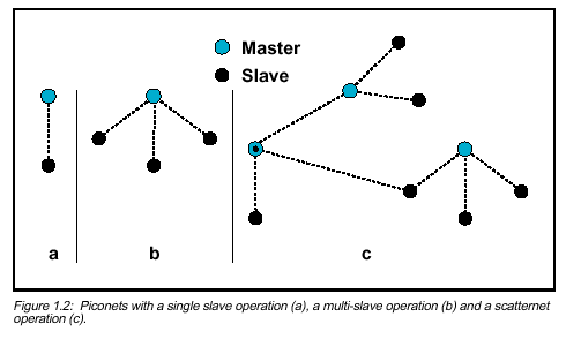
An interesting aspect of the technology is the instant formation of networks once the bluetooth devices come in range to each other. A piconet is a collection of devices connected via Bluetooth technology in an ad hoc fashion. A Piconet can be a simple connection between two devices or more than two devices. Multiple independent and non-synchronized piconets can form a scatternet. Any of the devices in a piconet can also be a member of another by means of time multiplexing i.e a device can be a part of more than one piconet by suitably sharing the time.
The Bluetooth system supports both point-to-point and point-to-multi-point connections. When a device is connected to another device it is a point to point connection. If it is connected to more that one (upto 7) it is a point to multipoint connection. Several piconets can be established and linked together ad hoc, where each piconet is identified by a different frequency hopping sequence. All users participating on the same piconet are synchronized to this hopping sequence. If a device is connected to more than one piconet it communicates in each piconet using a different hopping sequence. A piconet starts with two connected devices, such as a portable PC and cellular phone, and may grow to eight connected devices.
All Bluetooth devices are peer units and have identical implementations. However, when establishing a piconet, one unit will act as a master and the other(s) as slave(s) for the duration of the piconet connection. In a piconet there is a master unit whose clock and hopping sequence are used to synchronize all other devices in the piconet. All the other devices in a piconet that are not the master are slave units. A 3-bit MAC address is used to distinguish between units participating in the piconet. Devices synchronized to a piconet can enter power-saving modes called Sniff and hold mode, in which device activity is lowered. Also there can be parked units which are synchronized but do not have a MAC addresses. These parked units have an 8 bit address; therefore there can be a maximum of 256 parked devices.
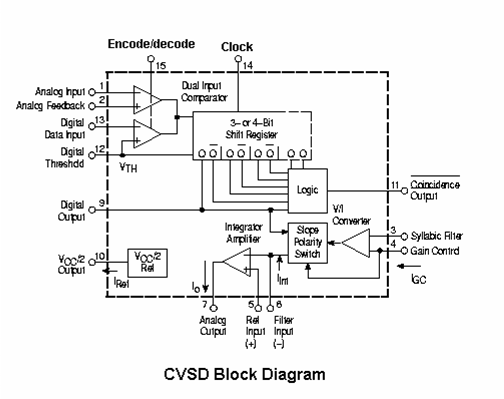
Voice channels use either a 64 kbps log PCM or the Continuous Variable Slope Delta Modulation (CVSD) voice coding scheme, and never retransmit voice packets. The voice quality on the line interface should be better than or equal to the 64 kbps log PCM. The CVSD method was chosen for its robustness in handling dropped and damaged voice samples. Rising interference levels are experienced as increased background noise: even at bit error rates up 4%, the CVSD coded voice is quite audible.
About the Author: Nupur Mittal is doing 3rd Year, B.E., Computer Science & Engg. Ghurdhauri, India. This is the first article on the BlueTooth Technology and the others will be published shortly. Please use the comments section to thank Nupur for the wonderful article series.
[catlist id=180].